The end of this semester should conclude your undergraduate career at the University of Central Florida. As you prepare for Commencement and look toward the future, I would encourage you to consider the advice that Steve Jobs, CEO of Apple Computer and of Pixar Animation Studios, provided at Stanford's 114th Commencement on June 12, 2005.
Make sure to use all of your talents and aptitudes to your advantage, make good use of your time, make informed and educated decisions, and make the most of each opportunity presented to you.
Best wishes in your future endeavors.
Friday, December 11, 2009

"What Are You Waiting For? Why Are You Not Being Everything You Can Be Right Now?"
The phrase Carpe Diem (Latin for "Seize the Day') has been around long before the movie Dead Poets Society brought it in to the pop-culture consciousness of America.
Turn the volume up and listen carefully as Gabrielle Bouliane challenges and inspires you with her performance from the Austin Poetry Slam.
CAUTION: Some language Not Safe For Work [NSFW]
Turn the volume up and listen carefully as Gabrielle Bouliane challenges and inspires you with her performance from the Austin Poetry Slam.
CAUTION: Some language Not Safe For Work [NSFW]
Friday, December 4, 2009
"You Are Brilliant, and the Earth is Hiring"
As the semester draws to a close and graduation approaches, you are [hopefully] preparing for life's next great adventure. Whether it be graduate education or a career in your chosen field of endeavor - there is always someone willing to share some wisdom and advice. This is not an assignment but I would encourage you to read the following, consider the information, feel good about the future and welcome the opportunities and challenges along the way.
The Commencement Address by Paul Hawken to the Class of 2009, University of Portland, May 3, 2009
http://yesmagazine.org/issues/columns/you-are-brilliant-and-the-earth-is-hiring
The Commencement Address by Paul Hawken to the Class of 2009, University of Portland, May 3, 2009
http://yesmagazine.org/issues/columns/you-are-brilliant-and-the-earth-is-hiring
Academia vs. Business cartoon
There is a saying that "art mirrors life" and this may be a pretty good example of one of the differences between academia and business. Enjoy.
From http://xkcd.com/664/
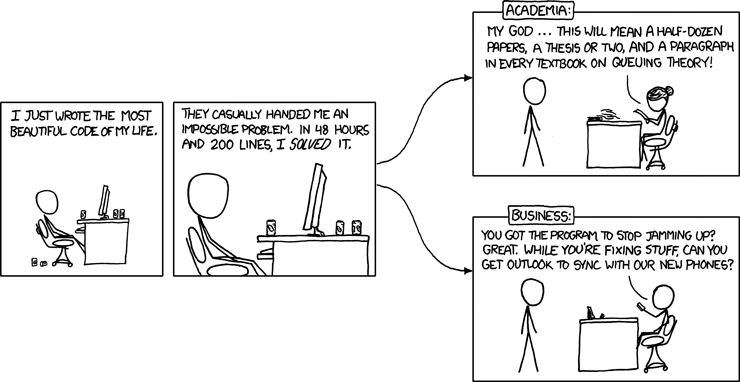
From http://xkcd.com/664/
"Don't Shrug Off Student Evaluations" article
The Chronicle of Higher Education, a publication focused on the world of post-secondary education and educators, recently (September 14, 2009) ran an article [Don't Shrug Off Student Evaluations] focusing on the importance of critical feedback and evaluation in classroom instruction from the faculty perspective.
Read the article at: http://chronicle.com/article/Dont-Shrug-Off-Student-Eva/48338/
WARNING!!! To access this article, you will need to do so from the UCF network. Why? UCF pays for a subscription that only gets authenticated via the network. If you attempt to access the article from somewhere other than UCF, you'll be asked to subscribe (which wouldn't be a bad thing but is not necessary for the sake of this assignment).
In the comments section, provide answers to the following questions in consideration of your own collegiate experiences.
1) How important do you feel honest, constructive feedback is in shaping undergraduate education?
2) What role do you think websites such as ratemyprofessor_dot_com play in sharing honest, constructive feedback with others?
3) In consideration of the current system we have for students assessing faculty instruction, is there a way we can improve this system? How?
Deadline to comment is Thursday, 12/10/2009, 11:59am
Read the article at: http://chronicle.com/article/Dont-Shrug-Off-Student-Eva/48338/
WARNING!!! To access this article, you will need to do so from the UCF network. Why? UCF pays for a subscription that only gets authenticated via the network. If you attempt to access the article from somewhere other than UCF, you'll be asked to subscribe (which wouldn't be a bad thing but is not necessary for the sake of this assignment).
In the comments section, provide answers to the following questions in consideration of your own collegiate experiences.
1) How important do you feel honest, constructive feedback is in shaping undergraduate education?
2) What role do you think websites such as ratemyprofessor_dot_com play in sharing honest, constructive feedback with others?
3) In consideration of the current system we have for students assessing faculty instruction, is there a way we can improve this system? How?
Deadline to comment is Thursday, 12/10/2009, 11:59am
"Interdisciplinary Hype" article
The Chronicle of Higher Education, a publication focused on the world of post-secondary education and educators, recently (November 22, 2009) ran an article [Interdisciplinary Hype] providing an alternative perspective on the utility and future of interdisciplinary education.
Read the article at: http://chronicle.com/article/Interdisciplinary-Hype/49191/
WARNING!!! To access this article, you will need to do so from the UCF network. Why? UCF pays for a subscription that only gets authenticated via the network. If you attempt to access the article from somewhere other than UCF, you'll be asked to subscribe (which wouldn't be a bad thing but is not necessary for the sake of this assignment).
In the comments section, provide answers to the following questions.
1) In consideration of the authors academic and experiential background, do you agree with his vision of interdisciplinary education? Why/why not?
2) What implications would there be for UCF if the author were selected as the Provost of this university?
3) Has this article changed your perspective on interdisciplinary education? Why or why not? If so, in what way(s)?
Deadline to comment is Thursday, 12/10/2009, 11:59am
Read the article at: http://chronicle.com/article/Interdisciplinary-Hype/49191/
WARNING!!! To access this article, you will need to do so from the UCF network. Why? UCF pays for a subscription that only gets authenticated via the network. If you attempt to access the article from somewhere other than UCF, you'll be asked to subscribe (which wouldn't be a bad thing but is not necessary for the sake of this assignment).
In the comments section, provide answers to the following questions.
1) In consideration of the authors academic and experiential background, do you agree with his vision of interdisciplinary education? Why/why not?
2) What implications would there be for UCF if the author were selected as the Provost of this university?
3) Has this article changed your perspective on interdisciplinary education? Why or why not? If so, in what way(s)?
Deadline to comment is Thursday, 12/10/2009, 11:59am
"Latin America Looks to Europe for Teaching Reform" article
The Chronicle of Higher Education, a publication focused on the world of post-secondary education and educators, recently (November 22, 2009) ran an article [Latin America Looks to Europe for Teaching Reform] focusing on efforts to transform Latin American higher education based on the European model.
Read the article at: http://chronicle.com/article/Latin-America-Looks-to-Euro/49214/
WARNING!!! To access this article, you will need to do so from the UCF network. Why? UCF pays for a subscription that only gets authenticated via the network. If you attempt to access the article from somewhere other than UCF, you'll be asked to subscribe (which wouldn't be a bad thing but is not necessary for the sake of this assignment).
In the comments section, provide answers to the following questions.
1) Is the Latin American model for higher education moving toward rote or experiential education? Explain.
2) If successful, what do you believe the results of this overhaul will mean for these college graduates?
3) How does this article relate to the "Needed: a New Generation of Problem Solvers" article [here]?
Deadline to comment is Thursday, 12/10/2009, 11:59am
Read the article at: http://chronicle.com/article/Latin-America-Looks-to-Euro/49214/
WARNING!!! To access this article, you will need to do so from the UCF network. Why? UCF pays for a subscription that only gets authenticated via the network. If you attempt to access the article from somewhere other than UCF, you'll be asked to subscribe (which wouldn't be a bad thing but is not necessary for the sake of this assignment).
In the comments section, provide answers to the following questions.
1) Is the Latin American model for higher education moving toward rote or experiential education? Explain.
2) If successful, what do you believe the results of this overhaul will mean for these college graduates?
3) How does this article relate to the "Needed: a New Generation of Problem Solvers" article [here]?
Deadline to comment is Thursday, 12/10/2009, 11:59am
"Foreign Demand Drops for American M.B.A.'s, Study Finds" article
The Chronicle of Higher Education, a publication focused on the world of post-secondary education and educators, recently (November 22, 2009) ran an article [Foreign Demand Drops for American M.B.A.'s, Study Finds] highlighting a reduction in the number of non-U.S. applicants to U.S. M.B.A. programs.
Read the article at: http://chronicle.com/article/Foreign-Demand-Drops-for-Am/49215/
WARNING!!! To access this article, you will need to do so from the UCF network. Why? UCF pays for a subscription that only gets authenticated via the network. If you attempt to access the article from somewhere other than UCF, you'll be asked to subscribe (which wouldn't be a bad thing but is not necessary for the sake of this assignment).
In the comments section, provide answers to the following questions.
1) In what way(s) does this information support or refute Pink's vision of the future?
2) Do you believe this reduction is based on current economic conditions or symptomatic of a trend? How so?
3) Is this reduction in non-U.S. applicants good or bad for U.S. applicants applying to U.S. M.B.A. programs? Explain.
Deadline to comment is Thursday, 12/10/2009, 11:59am
Read the article at: http://chronicle.com/article/Foreign-Demand-Drops-for-Am/49215/
WARNING!!! To access this article, you will need to do so from the UCF network. Why? UCF pays for a subscription that only gets authenticated via the network. If you attempt to access the article from somewhere other than UCF, you'll be asked to subscribe (which wouldn't be a bad thing but is not necessary for the sake of this assignment).
In the comments section, provide answers to the following questions.
1) In what way(s) does this information support or refute Pink's vision of the future?
2) Do you believe this reduction is based on current economic conditions or symptomatic of a trend? How so?
3) Is this reduction in non-U.S. applicants good or bad for U.S. applicants applying to U.S. M.B.A. programs? Explain.
Deadline to comment is Thursday, 12/10/2009, 11:59am
Tuesday, December 1, 2009
"Scientists and Engineers Are Plentiful; the Problem Lies With Their Jobs" article
The Chronicle of Higher Education, a publication focused on the world of post-secondary education and educators, recently (November 1, 2009) ran an article [Scientists and Engineers Are Plentiful; the Problem Lies With Their Jobs] focusing on the migration of science and technology graduates to other career fields.
Read the article at: http://chronicle.com/article/ScientistsEngineers-Ar/48948/
WARNING!!! To access this article, you will need to do so from the UCF network. Why? UCF pays for a subscription that only gets authenticated via the network. If you attempt to access the article from somewhere other than UCF, you'll be asked to subscribe (which wouldn't be a bad thing but is not necessary for the sake of this assignment).
In the comments section, provide answers to the following questions in consideration of your own collegiate experience and your expectations for attaining a career in your chosen field of endeavor.
1) Do you feel your IDS degree will make you competitive with graduates working outside of their degree fields? Why/why not?
2) Would you consider someone working outside of their degree field to be interdisciplinary? Why/why not?
3) Do you feel your IDS degree will be a help or hindrance when competing for jobs with individuals applying outside of their degree fields? Why/why not?
Deadline to comment is Thursday, 12/10/2009, 11:59am
Read the article at: http://chronicle.com/article/ScientistsEngineers-Ar/48948/
WARNING!!! To access this article, you will need to do so from the UCF network. Why? UCF pays for a subscription that only gets authenticated via the network. If you attempt to access the article from somewhere other than UCF, you'll be asked to subscribe (which wouldn't be a bad thing but is not necessary for the sake of this assignment).
In the comments section, provide answers to the following questions in consideration of your own collegiate experience and your expectations for attaining a career in your chosen field of endeavor.
1) Do you feel your IDS degree will make you competitive with graduates working outside of their degree fields? Why/why not?
2) Would you consider someone working outside of their degree field to be interdisciplinary? Why/why not?
3) Do you feel your IDS degree will be a help or hindrance when competing for jobs with individuals applying outside of their degree fields? Why/why not?
Deadline to comment is Thursday, 12/10/2009, 11:59am
Thursday, November 5, 2009
In-class Critiques for first round of Creative Project Presentations
Make a post on the number of presentations you critiqued in class today.
Due by Thursday, 11/05/09, 1:20pm
Due by Thursday, 11/05/09, 1:20pm
Friday, October 30, 2009
Presentation List for Research-Based Creative Project and Poster Presentation
As a reminder... all students will have up to 5 minutes for each of their two in-class presentations. Exceeding the time allowed for the presentation will result in a significant reduction in the assignment grade. I would strongly recommend that you practice each of your timed presentations in front of an audience (mirror, family, friends, strangers, pets, etc.) before presenting to the class. Some individuals are excellent at extemporaneous speaking but most are terrible and the grade for these assignments is equally dependent on the content of the research/poster as on the presentation itself.
The following students will present their Research-Based Creative Project (listed as the eJournal project in the syllabus) on the following dates:
Thursday, 11/05/09
- Lisa B.
- Dani D.
- Mary W.
- Brian V.
- Janelle W.
- Kaitlyn F.
- Natyeli C.
Thursday, 11/12/09
- Rhonda B.
- Peter L.
- Joseph Z.
- Kati O.
- Scott S.
- Gina T.
- Amanda F.
- Monica B.
- Ada B.
- Cheyenne B.
- Rob W.
- Shellee K.
- Rich C.
Thursday, 11/19/09
- John Z.
- Michael G.
- Jessica W.
- Ryan K.
- Justin S.
- Andres G.
- Patrick W.
The following students will present their Poster on the following dates:
Thursday, 11/19/09
- Lisa B.
- Dani D.
- Mary W.
- Brian V.
Thursday, 12/03/09
- Janelle W.
- Kaitlyn F.
- Natyeli C.
- Rhonda B.
- Peter L.
- Joseph Z.
- Kati O.
- Scott S.
- Gina T.
- Amanda F.
- Monica B.
- Ada B.
Thursday, 12/10/09
- Cheyenne B.
- Rob W.
- Shellee K.
- Rich C.
- John Z.
- Michael G.
- Jessica W.
- Ryan K.
- Justin S.
- Andres G.
- Patrick W.
In the comments section, acknowledge that you have reviewed your assigned presentation dates and indicate if you would prefer to swap dates with someone else or keep your dates.
Deadline to comment is Sunday, 11/01/2009, 11:59pm
The following students will present their Research-Based Creative Project (listed as the eJournal project in the syllabus) on the following dates:
Thursday, 11/05/09
- Lisa B.
- Dani D.
- Mary W.
- Brian V.
- Janelle W.
- Kaitlyn F.
- Natyeli C.
Thursday, 11/12/09
- Rhonda B.
- Peter L.
- Joseph Z.
- Kati O.
- Scott S.
- Gina T.
- Amanda F.
- Monica B.
- Ada B.
- Cheyenne B.
- Rob W.
- Shellee K.
- Rich C.
Thursday, 11/19/09
- John Z.
- Michael G.
- Jessica W.
- Ryan K.
- Justin S.
- Andres G.
- Patrick W.
The following students will present their Poster on the following dates:
Thursday, 11/19/09
- Lisa B.
- Dani D.
- Mary W.
- Brian V.
Thursday, 12/03/09
- Janelle W.
- Kaitlyn F.
- Natyeli C.
- Rhonda B.
- Peter L.
- Joseph Z.
- Kati O.
- Scott S.
- Gina T.
- Amanda F.
- Monica B.
- Ada B.
Thursday, 12/10/09
- Cheyenne B.
- Rob W.
- Shellee K.
- Rich C.
- John Z.
- Michael G.
- Jessica W.
- Ryan K.
- Justin S.
- Andres G.
- Patrick W.
In the comments section, acknowledge that you have reviewed your assigned presentation dates and indicate if you would prefer to swap dates with someone else or keep your dates.
Deadline to comment is Sunday, 11/01/2009, 11:59pm
Tuesday, October 27, 2009
Navigating Your ePortfolio
Jason Buckner with CDWS joined us in class last week to discuss the ePortfolio and provide an overview on navigating and building the ePortfolio. In class, I indicated there were 5 tutorials covering the following topics:
1) Using the Matrix
2) Creating Your About Me Page
3) Making Headlines
4) Making Your Online Resume
5) Creating Your Presentation
Do The Following:
1) Log into myUCF. Toward the top of the page you will see grey-colored tabs, the last one on the right is labeled "Online Course Tools."
2) Click on the Online Course Tools tab.
3) Scroll toward the bottom of the page and locate the "ePortfolio@UCF" section on the right side.
4) Watch all five tutorials (or read the .pdf files) by clicking the green-colored film strip icon or clicking the red and white PDF icon to the right of each topic - making sure to practice the tutorials until you are familiar with the content discussed in each tutorial.
In the comments section, post any questions you may have based on reviewing the tutorials.
Deadline to comment is Thursday, 10/29/2009, 11:59am
1) Using the Matrix
2) Creating Your About Me Page
3) Making Headlines
4) Making Your Online Resume
5) Creating Your Presentation
Do The Following:
1) Log into myUCF. Toward the top of the page you will see grey-colored tabs, the last one on the right is labeled "Online Course Tools."
2) Click on the Online Course Tools tab.
3) Scroll toward the bottom of the page and locate the "ePortfolio@UCF" section on the right side.
4) Watch all five tutorials (or read the .pdf files) by clicking the green-colored film strip icon or clicking the red and white PDF icon to the right of each topic - making sure to practice the tutorials until you are familiar with the content discussed in each tutorial.
In the comments section, post any questions you may have based on reviewing the tutorials.
Deadline to comment is Thursday, 10/29/2009, 11:59am
Monday, October 26, 2009
No Course Blog Assignments due Sunday, 10/25/09
The next round of Course Blog Assignments will be due Thursday, 10/29/09
Monday, October 19, 2009
The Big Deal on Small Talk
A significant focus of this course has been on the value of effective communication. We've completed a number of writing assignments in class and on the Course Blog focused on the 50-word essay (much to the delight or chagrin of most of you) but let's now shift the focus to oral communication and social interactions for a bit.
Julia Feldmeier discusses the essentials of initial social communication etiquette (small talk) in her article, The Art of Small Talk, from The Washington Post, 02/10/08
Read the article at: http://www.washingtonpost.com/wp-dyn/content/story/2008/02/08/ST2008020801605.html
CareerBuilder.com also provides some context for the importance of and tips for making small talk (via CNN.com, 03/04/05) in their article titled, 12 Tips for Making Small Talk.
Read the article at: http://www.cnn.com/2005/US/Careers/03/03/small.talk/index.html
In the comments section, respond to the following prompts:
1) List 5 topics of conversation that you would feel comfortable using as icebreakers that would lead to small talk.
2) List as many nonverbal cues as you are familiar with that may signal a change in the flow of the conversation.
3) List 3-4 appropriate exit strategies for politely ending a conversation.
Deadline to comment is Thursday, 10/22/2009, 11:59am
Julia Feldmeier discusses the essentials of initial social communication etiquette (small talk) in her article, The Art of Small Talk, from The Washington Post, 02/10/08
Read the article at: http://www.washingtonpost.com/wp-dyn/content/story/2008/02/08/ST2008020801605.html
CareerBuilder.com also provides some context for the importance of and tips for making small talk (via CNN.com, 03/04/05) in their article titled, 12 Tips for Making Small Talk.
Read the article at: http://www.cnn.com/2005/US/Careers/03/03/small.talk/index.html
In the comments section, respond to the following prompts:
1) List 5 topics of conversation that you would feel comfortable using as icebreakers that would lead to small talk.
2) List as many nonverbal cues as you are familiar with that may signal a change in the flow of the conversation.
3) List 3-4 appropriate exit strategies for politely ending a conversation.
Deadline to comment is Thursday, 10/22/2009, 11:59am
David Hanson's "Robots that show emotion" lecture
Following up our discussion in class this past Thursday on empathy (and to a lesser extent, technology and automation)... watch the following lecture and think critically about the future.
In the comments section, take into consideration Pink's position when answering the following questions:
1) What impact, if any, do you believe empathetic robots will have in the future? In what industries?
2) Do you believe there are any ethical concerns in the creation of empathetic robots?
3) What impact does the creation of empathetic robots have on Pink's forecast of the future?
Deadline to comment is Thursday, 10/22/2009, 11:59am
In the comments section, take into consideration Pink's position when answering the following questions:
1) What impact, if any, do you believe empathetic robots will have in the future? In what industries?
2) Do you believe there are any ethical concerns in the creation of empathetic robots?
3) What impact does the creation of empathetic robots have on Pink's forecast of the future?
Deadline to comment is Thursday, 10/22/2009, 11:59am
Friday, October 16, 2009
"Success is a Continuous Journey" lecture
Volumes have been written in the business community on the keys to success. Watch the following lecture by Richard St. John on his rise to, fall from, and subsequent rise back to success.
In the comments section, answer the following questions:
1) Do your personal steps to success match Richard's? In what ways are they similar/different?
2) What steps can one take to maintain success once achieved?
3) How do you define success? How will you know when you've achieved it?
Deadline to comment is Sunday, 10/18/2009, 11:59pm
In the comments section, answer the following questions:
1) Do your personal steps to success match Richard's? In what ways are they similar/different?
2) What steps can one take to maintain success once achieved?
3) How do you define success? How will you know when you've achieved it?
Deadline to comment is Sunday, 10/18/2009, 11:59pm
Thursday, October 15, 2009
Where Do I Stand?
In class last week 10/08/09, I promised I would have your intermediate grade available in advance of the withdrawal deadline for the Fall term.
In the comments section, list your name and Knightsmail e-mail address and I will forward a breakdown of your grades as of Monday 10/12/09. If you have any questions based on the information you receive, visit me during office hours and we can discuss further.
Deadline to comment is Sunday, 10/18/2009, 11:59pm
In the comments section, list your name and Knightsmail e-mail address and I will forward a breakdown of your grades as of Monday 10/12/09. If you have any questions based on the information you receive, visit me during office hours and we can discuss further.
Deadline to comment is Sunday, 10/18/2009, 11:59pm
Sign-up for Research-based Creative Project
In class last week 10/08/09, we discussed the presentation dates of the research-based creative project as Thursday 11/05/09, 11/12/09, and 11/19/09.
In the comments section, indicate your preference for the date on which you would prefer to present - indicate 1st, 2nd, and 3rd choices. If you have no preference, indicate such.
Deadline to comment is Sunday, 10/18/2009, 11:59pm
In the comments section, indicate your preference for the date on which you would prefer to present - indicate 1st, 2nd, and 3rd choices. If you have no preference, indicate such.
Deadline to comment is Sunday, 10/18/2009, 11:59pm
Tuesday, October 13, 2009
No Course Blog Assignments due Thursday, 10/15/09
The next round of Course Blog Assignments will be due Sunday, 10/18/09
I will be providing current grades for students on Thursday during class in advance of the withdrawal deadline.
I will be providing current grades for students on Thursday during class in advance of the withdrawal deadline.
Friday, October 9, 2009
Dan Pink's "Science of Motivation" lecture
Dan Pink appears on the TED stage to host a talk on the science of motivation. Using research findings from behavioral economists, Pink offers a prescriptive view of how to improve motivation from a management perspective. As you prepare for graduation and life beyond college, consider your role as a future leader within your chosen field and reflect on how you will use this knowledge of motivation as you embark on your career path.
Watch the video and answer the questions below in the comments section.
In the comments section, answer the following questions:
1) Did you find the research findings of the behavioral economists cited by Pink to be intuitive? Why or why not?
2) In what field(s) do you believe the ROWE model may work best? Why?
3) Given the findings and the recommendations made by Pink, in what way(s) do you anticipate using this information once you attain a leadership role within your organization?
Deadline to comment is Sunday, 10/11/2009, 11:59pm
Watch the video and answer the questions below in the comments section.
In the comments section, answer the following questions:
1) Did you find the research findings of the behavioral economists cited by Pink to be intuitive? Why or why not?
2) In what field(s) do you believe the ROWE model may work best? Why?
3) Given the findings and the recommendations made by Pink, in what way(s) do you anticipate using this information once you attain a leadership role within your organization?
Deadline to comment is Sunday, 10/11/2009, 11:59pm
"Needed: a New Generation of Problem Solvers" article
The Chronicle of Higher Education, a publication focused on the world of post-secondary education and educators, ran an article [Needed: a New Generation of Problem Solvers] in their June 26, 2009 edition where the authors cite complex and interconnected global problems to support the International Commission on Education for Sustainable Development Practice's three recommendations for higher education and beyond.
Read the article at: http://chronicle.com/weekly/v55/i40/40a06401.htm
Note: to access this article, you may need to be on UCF's network either through a wi-fi connection or via one of the computers in the computer lab.
In the comments section, answer the following questions:
1) In what ways does the Commission's recommendations support or refute the need for interdisciplinary education and training?
2) Who would benefit most from the M.D.P. program? Would you benefit from this program? Why/why not?
3) Should colleges and universities adopt this M.D.P. model or seek to create a graduate program that is uniquely tailored to the mission of their institution? Why/why not?
Deadline to comment is Sunday, 10/11/2009, 11:59pm
Read the article at: http://chronicle.com/weekly/v55/i40/40a06401.htm
Note: to access this article, you may need to be on UCF's network either through a wi-fi connection or via one of the computers in the computer lab.
In the comments section, answer the following questions:
1) In what ways does the Commission's recommendations support or refute the need for interdisciplinary education and training?
2) Who would benefit most from the M.D.P. program? Would you benefit from this program? Why/why not?
3) Should colleges and universities adopt this M.D.P. model or seek to create a graduate program that is uniquely tailored to the mission of their institution? Why/why not?
Deadline to comment is Sunday, 10/11/2009, 11:59pm
Dr. Jill Bolte Taylor's "Stroke of Insight" lecture
Dan Pink's A Whole New Mind talks about the two hemispheres of the brain and what functions they serve. Watch this video of Dr. Jill Bolte Taylor, a Harvard-trained and published neuroanatomist who serves as the National Spokesperson for the Harvard Brain Tissue Resource Center (among other things), as she recounts her experience with a severe hemorrhage in the left hemisphere of her brain.
Note: there is an actual brain shown as part of the presentation from 2:40 to 3:50 as Dr. Taylor discusses the parts and functions of the brain. If you are squeamish, keep listening as the discussion is informative but stare at the ceiling for about a minute and then resume watching.
In the comments section, answer the following questions:
1) How does Dr. Taylor's discussion relate to the information presented by Dan Pink?
2) What impact would you expect if Dr. Taylor had a hemorrhage in her right hemisphere instead of her left?
3) How do you feel about Dr. Taylor's overall presentation?
Deadline to comment is Sunday, 10/11/2009, 11:59pm
Note: there is an actual brain shown as part of the presentation from 2:40 to 3:50 as Dr. Taylor discusses the parts and functions of the brain. If you are squeamish, keep listening as the discussion is informative but stare at the ceiling for about a minute and then resume watching.
In the comments section, answer the following questions:
1) How does Dr. Taylor's discussion relate to the information presented by Dan Pink?
2) What impact would you expect if Dr. Taylor had a hemorrhage in her right hemisphere instead of her left?
3) How do you feel about Dr. Taylor's overall presentation?
Deadline to comment is Sunday, 10/11/2009, 11:59pm
Tuesday, October 6, 2009
No Course Blog Assignments due Thursday, 10/08/09
The next round of Course Blog Assignments will be due Sunday, 10/11/09
Friday, October 2, 2009
Does Knowledge Matter if it is Not on the Test?
Your Capstone course features several projects and ongoing academic responsibilities but no "tests" per se. I hear the concern/criticism all too often that students have to read books and listen to lectures but the material they are learning is not always tested in the course. This may lead one to question why would students be required to learn anything which would not be assessed via quiz, paper, project, or examination.
The following music video captures the spirit and sentiment of so many educators (especially since state-wide standardized testing began influencing budgetary decisions)...
No comments required for this post, just consider that learning is always the goal, not testing.
Have a good weekend and keep working on those research-based creative project ideas (& your Mentorship Blog, reading Pink's A Whole New Mind, and practicing your effective communication skills for your service experience).
The following music video captures the spirit and sentiment of so many educators (especially since state-wide standardized testing began influencing budgetary decisions)...
No comments required for this post, just consider that learning is always the goal, not testing.
Have a good weekend and keep working on those research-based creative project ideas (& your Mentorship Blog, reading Pink's A Whole New Mind, and practicing your effective communication skills for your service experience).
Research-Based Creative Project Idea Incubator
We spent quite a bit of time toward the end of class this past Thursday discussing the research-based creative project that will be due toward the end of the semester. I had asked you to consider research related to your chosen field of endeavor tied with UCF's Unifying Theme: Globate Climate Change (in essence, researching an aspect of how your field impacts the environment or how the environment impacts your field - and creating a research-based creative project based on your research).
In the comments section, indicate:
1) What are your draft research topics (i.e. what do you think you'd like to research)?
2) What media (electronic, print, sculpture, painting, etc.) are you considering for your creative project?
Deadline to comment is Sunday, 10/04/2009, 11:59pm
1) What are your draft research topics (i.e. what do you think you'd like to research)?
2) What media (electronic, print, sculpture, painting, etc.) are you considering for your creative project?
Deadline to comment is Sunday, 10/04/2009, 11:59pm
Monday, September 28, 2009
Requiring Technology to Facilitate Learning?
With just one decade into the 21st century, it seems the educational community is beginning to adopt technology as a vehicle for teaching and learning. Read the following articles and respond in the comments section:
6 Lessons One Campus Learned About E-Textbooks
http://chronicle.com/article/6-Lessons-One-Campus-Learne/44440/
iPhones to go to front of the class at Texas university
http://www.macworld.com/article/136019/2008/10/abilene_iphone.html
Missouri journalism students required to buy iPhone or iPod touch?
http://www.macworld.com/article/140522/2009/05/missouri_journalism.html
In the comments section, consider the information contained in the articles and answer the following questions:
1) What types of technology do you believe would be most useful in supplementing classroom learning?
2) Should this technology be required or optional?
3) Would students who are unable to afford this technology be at an educational disadvantage?
4) What do you think the future holds for the adoption of technology by colleges and universities?
Deadline to comment is Thursday, 10/01/2009, 11:59am
6 Lessons One Campus Learned About E-Textbooks
http://chronicle.com/article/6-Lessons-One-Campus-Learne/44440/
iPhones to go to front of the class at Texas university
http://www.macworld.com/article/136019/2008/10/abilene_iphone.html
Missouri journalism students required to buy iPhone or iPod touch?
http://www.macworld.com/article/140522/2009/05/missouri_journalism.html
In the comments section, consider the information contained in the articles and answer the following questions:
1) What types of technology do you believe would be most useful in supplementing classroom learning?
2) Should this technology be required or optional?
3) Would students who are unable to afford this technology be at an educational disadvantage?
4) What do you think the future holds for the adoption of technology by colleges and universities?
Deadline to comment is Thursday, 10/01/2009, 11:59am
"Teaching Arts and Sciences Together" lecture
Mae Jemison is an astronaut, a doctor, an art collector, a dancer ... Telling stories from her own education and from her time in space, she calls on educators to teach both the arts and sciences, both intuition and logic, as one -- to create bold thinkers. (Bio provided by TED)
In her lecture on the importance of teaching arts and sciences together, Dr. Jemison states: "science provides an understanding of a universal experience and arts provides a universal understanding of a personal experience" as she advocates for the integrated teaching of both.
Watch the video and answer the questions below in the comments section.
In the comments section, answer the following questions:
1) Is Dr. Jemison advocating an interdisciplinary approach to teaching content? Why or why not? Provide examples where this approach may or may not be useful in classroom instruction.
2) Should all subjects be taught from an interdisciplinary perspective? Why or why not? Provide examples where this may be helpful or detrimental.
Deadline to comment is Thursday, 10/01/2009, 11:59am
In her lecture on the importance of teaching arts and sciences together, Dr. Jemison states: "science provides an understanding of a universal experience and arts provides a universal understanding of a personal experience" as she advocates for the integrated teaching of both.
Watch the video and answer the questions below in the comments section.
In the comments section, answer the following questions:
1) Is Dr. Jemison advocating an interdisciplinary approach to teaching content? Why or why not? Provide examples where this approach may or may not be useful in classroom instruction.
2) Should all subjects be taught from an interdisciplinary perspective? Why or why not? Provide examples where this may be helpful or detrimental.
Deadline to comment is Thursday, 10/01/2009, 11:59am
Friday, September 25, 2009
Six Word Memoirs and Six Word Stories
Focusing on the essence of meaning within communication, let's examine a few forms of communication that seek to convey meaning without the excessive use of words - Six Word Memoirs and Six Word Stories (described in this post) and One Word Equity (described in the following post).
Six Word Memoirs and Six Word Stories were both inspired by the legend that the venerable writer, Ernest Hemingway, was challenged to write a complete story in just six words. Supposedly, Hemingway wrote, "For Sale: baby shoes, never worn." (or "For Sale: baby shoes, never used." depending on your source).
Take a look at Six Word Memoirs at: http://www.npr.org/templates/story/story.php?storyId=18768430
and Six Word Stories at: http://www.sixwordstories.net/
In the comments section, exercise your creativity and brevity by writing 3 six word stories: 1) describing your childhood; 2) describing your collegiate experience; and 3) describing your future plans.
Deadline to comment is Sunday, 09/27/2009, 11:59pm
Six Word Memoirs and Six Word Stories were both inspired by the legend that the venerable writer, Ernest Hemingway, was challenged to write a complete story in just six words. Supposedly, Hemingway wrote, "For Sale: baby shoes, never worn." (or "For Sale: baby shoes, never used." depending on your source).
Take a look at Six Word Memoirs at: http://www.npr.org/templates/story/story.php?storyId=18768430
and Six Word Stories at: http://www.sixwordstories.net/
In the comments section, exercise your creativity and brevity by writing 3 six word stories: 1) describing your childhood; 2) describing your collegiate experience; and 3) describing your future plans.
Deadline to comment is Sunday, 09/27/2009, 11:59pm
One Word Equity
We have spent a great deal of time this semester discussing the importance of creativity, critical thinking, and effective communication. M&C Saatchi, a global advertising and marketing agency, attempts to distill the essence of identity to a single word using what they term "one word equity" - branding a company with a single word. Take a look at their website (caution: Flash intensive site, navigate by mousing over the crumpled piece of paper and clicking the appropriate link) at: http://www.onewordequity.com/ The most enlightening views on this topic are within the "HEAR" section - you'll need to press the play button on the mp3 player to listen to the interview.
What do you think? Is it possible to have a single word describe a company, individual, or entity? Can a company define a product or service? What about using Xerox to describe a photocopy, Kleenex to describe facial tissue, or Post-It to describe repositionable self-adhesive notes? Is Volvo synonymous with safety and do you think of President Obama when you see or hear the words change or hope? Can the use of a single word be an effective means of communication?
In the comments section, carefully consider the questions asked above and create a one word descriptor for: 1) UCF; and 2) yourself. Make sure to include an explanation as to why you chose that particular one word descriptor.
Deadline to comment is Sunday, 09/27/2009, 11:59pm
What do you think? Is it possible to have a single word describe a company, individual, or entity? Can a company define a product or service? What about using Xerox to describe a photocopy, Kleenex to describe facial tissue, or Post-It to describe repositionable self-adhesive notes? Is Volvo synonymous with safety and do you think of President Obama when you see or hear the words change or hope? Can the use of a single word be an effective means of communication?
In the comments section, carefully consider the questions asked above and create a one word descriptor for: 1) UCF; and 2) yourself. Make sure to include an explanation as to why you chose that particular one word descriptor.
Deadline to comment is Sunday, 09/27/2009, 11:59pm
Monday, September 21, 2009
Everbody Needs Theme Music
For years I've held fast to the belief that everbody needs theme music. Just as movies have a score or background music that helps convey mood and tone, I believe that everyone should have a score (or song) that plays internally to help define their emotional state and provide a context for life's events. This personal score or theme music may serve to elevate one's mood, encourage, motivate, energize, or have other effects but it would be context specific and unique to the individual.
A student named Julie Ouedraogo at UMBC read Pink's AWNM and wrote a song about it for a class assignment. Dan Pink enjoyed this tribute enough to post it to his blog at: http://www.danpink.com/archives/2008/05/guest-blogger-julie-ouedraogo
A student named Julie Ouedraogo at UMBC read Pink's AWNM and wrote a song about it for a class assignment. Dan Pink enjoyed this tribute enough to post it to his blog at: http://www.danpink.com/archives/2008/05/guest-blogger-julie-ouedraogo
In the comments section, answer the following:
1) Do you have theme music? If so, what is it? If not, why not?
If you have theme music, answer the following:
2) Is your theme music situation specific? What is the context for your theme music?
3) Has your theme music changed over time?
4) How does your theme music affect your mood, outlook, or perception?
Deadline to comment is Thursday, 09/24/2009, 11:59am
1) Do you have theme music? If so, what is it? If not, why not?
If you have theme music, answer the following:
2) Is your theme music situation specific? What is the context for your theme music?
3) Has your theme music changed over time?
4) How does your theme music affect your mood, outlook, or perception?
Deadline to comment is Thursday, 09/24/2009, 11:59am
A Whole New Comment
We've been reading Dan Pink's A Whole New Mind as the course text for this Capstone section. This text was chosen as a means of engaging students in communication, creativity, and critical thinking while providing fodder for discussion and reflection.
In the comments section, state: 1) three things you have learned so far from your readings that you feel may be useful as you plan for the future; and 2) your opinion on the utility/usefulness of a trade book (Pink's AWNM) in place of a traditional textbook at engaging students in the course objectives - for comparison, see Joe Moran's Interdisciplinarity (2002), which is much more focused strictly on interdisciplinarity (no need to comment on the price... yes, Pink's book is cheaper).
Deadline to comment is Thursday, 09/24/2009, 11:59am
Deadline to comment is Thursday, 09/24/2009, 11:59am
Friday, September 18, 2009
NEW MATH by Craig Damrauer
Craig Damrauer has combined words with mathematical expressions to convey meaning (and in some instances, comedy) in a creatively visual manner. Take a look at his website at: http://www.morenewmath.com/ and explore his expressions of communication.
Does this engage your L-directed thinking or R-directed thinking?
In the comments section, post your favorite equation from Craig Damrauer and create and post two of your own word equations, one pertaining to UCF and another pertaining to your intended post-collegiate plans.
Deadline to comment is Sunday, 09/20/2009, 11:59pm
Does this engage your L-directed thinking or R-directed thinking?
In the comments section, post your favorite equation from Craig Damrauer and create and post two of your own word equations, one pertaining to UCF and another pertaining to your intended post-collegiate plans.
Deadline to comment is Sunday, 09/20/2009, 11:59pm
An Old Story Told in a New Way
During the second week of class we discussed the importance of communication and story telling. See if you can recognize this thoroughly modern telling of an old story: http://www.vimeo.com/3514904
* You may need to update your version of Adobe Flash to view the movie
In the comments section, answer the following questions:
1) What do you think? Did you prefer this interpretation over the original or is the original still the best?
2) Does the manner in which this story is told make this story more or less interesting?
3) How does the manner in which a story is told impact the audience? To what type of audience would you expect this to appeal vs. the original?
4) Can the creativity of the storyteller compete with the imagination of the audience (i.e. watching the movie vs. reading the book)?
5) What considerations will you make when telling a story?
Deadline to comment is Sunday, 09/20/2009, 11:59pm
* You may need to update your version of Adobe Flash to view the movie
In the comments section, answer the following questions:
1) What do you think? Did you prefer this interpretation over the original or is the original still the best?
2) Does the manner in which this story is told make this story more or less interesting?
3) How does the manner in which a story is told impact the audience? To what type of audience would you expect this to appeal vs. the original?
4) Can the creativity of the storyteller compete with the imagination of the audience (i.e. watching the movie vs. reading the book)?
5) What considerations will you make when telling a story?
Deadline to comment is Sunday, 09/20/2009, 11:59pm
Tuesday, September 15, 2009
"Are We in Control of Our Own Decisions?" lecture
In class this past Thursday we discussed desires, expectations, and outcomes in the context of making decisions and setting goals. Dan Ariely, a behavioral economist and author of Predictably Irrational, hosts a TED Talk reflecting on whether or not we are in control of our own decisions.
Watch the video and answer the questions below in the comments section.
In the comments section, indicate what you found most surprising about this presentation and what you found most helpful. How can critical thinking skills guide and shape your behavior?
Deadline to comment is Thursday, 09/17/2009, 11:59am
Watch the video and answer the questions below in the comments section.
In the comments section, indicate what you found most surprising about this presentation and what you found most helpful. How can critical thinking skills guide and shape your behavior?
Deadline to comment is Thursday, 09/17/2009, 11:59am
"Schools tap '21st-century skills'" article
Stacy Teicher Khadaroo, writing for The Christian Science Monitor, highlights the disconnect between how students are prepared for the world of work and the reality of working in the world.
Read the article at: http://www.csmonitor.com/2009/0108/p03s03-usgn.html

In the comments section, provide answers to the following questions in consideration of your expectations for working in a global economy and ramifications for the future.
1) What conclusions can be drawn from the research findings of the "Ready to Innovate" report?
2) What impact will this have on you as [possibly] future parents of students educated in American schools?
3) In what way(s) does the information presented in this article tie-in with Pink's A Whole New Mind?
Deadline to comment is Thursday, 09/17/2009, 11:59am
Read the article at: http://www.csmonitor.com/2009/0108/p03s03-usgn.html
In the comments section, provide answers to the following questions in consideration of your expectations for working in a global economy and ramifications for the future.
1) What conclusions can be drawn from the research findings of the "Ready to Innovate" report?
2) What impact will this have on you as [possibly] future parents of students educated in American schools?
3) In what way(s) does the information presented in this article tie-in with Pink's A Whole New Mind?
Deadline to comment is Thursday, 09/17/2009, 11:59am
Saturday, September 12, 2009
Making [Good] Conversation [Well]
Much is written on the importance of social networking both for personal enjoyment and professional advancement but how many people know how to do it well?
Read Gretchen Rubin's "Seven Tips for Making Good Conversation with a Stranger" on her The Happiness Project blog at: http://www.happiness-project.com/happiness_project/2009/05/seven-tips-for-making-good-conversation-with-a-stranger.html
In the comments section, see if you can add an additional tip from your personal repertoire that has proven effective for you in fostering conversation (or, if you can't think of a positive one, offer a tip on what to avoid saying that might stifle conversation).
Deadline to comment is Sunday, 09/13/2009, 11:59pm
Read Gretchen Rubin's "Seven Tips for Making Good Conversation with a Stranger" on her The Happiness Project blog at: http://www.happiness-project.com/happiness_project/2009/05/seven-tips-for-making-good-conversation-with-a-stranger.html
In the comments section, see if you can add an additional tip from your personal repertoire that has proven effective for you in fostering conversation (or, if you can't think of a positive one, offer a tip on what to avoid saying that might stifle conversation).
Deadline to comment is Sunday, 09/13/2009, 11:59pm
"10 Things Science Says Will Make You Happy" article
In class this past Thursday we discussed desires, expectations, and goals. These three things, along with effort, aptitude, and direction can lead to a rewarding and fulfilling life and career. However, many recent college graduates find the transition from college-life to post-collegiate living to be extremely stressful and a source of personal unhappiness (or misery in extreme cases). What can/should one do?
One of the by-products of a depressed economy is a shift in focus from material goods/wealth to an emphasis on satisfaction and happiness (i.e. since you can't afford anything, might as well make the best with what you have). As you read the following article, reproduced on alternet.org from YES! Magazine, consider what role personal and career satisfaction/happiness will play in your post-collegiate life.
Read the article at: http://www.alternet.org/healthwellness/111138/10_things_science_says_will_make_you_happy/?page=entire
In the comments section, provide answers to the following questions in consideration of your expectations for personal and career satisfaction/happiness.
1) How many of these 10 things do you currently do? How many do you expect to do in the future?
2) Do you believe there is a relationship (causal or correlational) between personal happiness and career satisfaction? If not, why not? If so, in what way?
Deadline to comment is Sunday, 09/13/2009, 11:59pm
Read the article at: http://www.alternet.org/healthwellness/111138/10_things_science_says_will_make_you_happy/?page=entire
In the comments section, provide answers to the following questions in consideration of your expectations for personal and career satisfaction/happiness.
1) How many of these 10 things do you currently do? How many do you expect to do in the future?
2) Do you believe there is a relationship (causal or correlational) between personal happiness and career satisfaction? If not, why not? If so, in what way?
Deadline to comment is Sunday, 09/13/2009, 11:59pm
Friday, September 11, 2009
Mentorship Blog Project: The Topics and Schedule
The schedule for the Mentorship Blog Project topics is listed below along with the deadlines for each initial post and ensuing dialogue. After reading this post, if you have any questions just post them in the comments section and I'll answer them here or discuss at the next class meeting as appropriate.
Here's what is expected of each mentoring team:
1) Both students (i.e. the whole team) will work together collaboratively to create a single new post each week based on the provided list of topics. Not sure what to talk about? That's why we've included talking points with the topics to get the conversation started and headed in the right direction. Your post should be insightful, informative, and engaging - so much so that your mentees will actually want to participate in your discussion (not just because their grade will go into freefall otherwise). But wait, there's more...
2) Once the initial new post has been made by you for the week, your Cornerstone mentees are supposed to engage in the discussion by telling their story, asking questions, or a combo of the two - you must keep communicating. Respond to their responses, responding to your initial post, and keep going until the week ends and you introduce the next topic the following week.
4) Additional fine print: The goal of the mentoring team is to have you work together collaboratively to provide guidance and leadership to the students in the Cornerstone course this semester. The mentoring team is not an opportunity for two people to exercise a division of labor and do half the work to get things done.
Stated mathematically:
Collaborative approach
Mentor A (100% participation) + Mentor B (100% participation) = a grade of 100% for both Mentor A and Mentor B
Division of labor approach
Mentor A (50% participation) + Mentor B (50% participation) = a grade of 50% for both Mentor A and Mentor B
Here's the schedule and topics:
Wk 3: initial post due by Sunday, Sept. 13, 11:59 p.m.
Introductions: Getting to Know You
Explaining the IDS degree
Who are you? What are your areas / minors? What year are you?
How do you explain IDS to others?
What are the advantages/disadvantages of an interdisciplinary education
Wk 4: initial post due by Sunday, Sept. 20, 11:59 p.m.
E-Portfolio
How will your e-Portfolio demonstrate your interdisciplinarity?
What is the audience / purpose you're thinking of using?
How would you envision your e-Portfolio looking like? What would you like to stand out?
What things are you thinking could be used as evidence?
How will your e-Portfolio demonstrate your interdisciplinarity?
What is the audience / purpose you're thinking of using?
How would you envision your e-Portfolio looking like? What would you like to stand out?
What things are you thinking could be used as evidence?
Wk 5: initial post due by Sunday, Sept. 27, 11:59 p.m.
Understanding Interdisciplinarity
Integrating Areas
What is integration? What are examples?
How have or haven't you integrated your areas and minor?
Why is integration of areas/minor important in terms of professional, academic, and/or personal developing
How can your areas/minor be better integrated?
Integrating Areas
What is integration? What are examples?
How have or haven't you integrated your areas and minor?
Why is integration of areas/minor important in terms of professional, academic, and/or personal developing
How can your areas/minor be better integrated?
Wk 6: initial post due by Sunday, Oct. 4, 11:59 p.m.
Critical Thinking
How does your critical thinking relate to being interdisciplinary?
Comment on how the Virtual Philosopher scored your response. From the comments you received about your responses, what insight have you gained about your own critical thinking and reasoning? How does the outline of your critical thinking disposition match with the application of it in doing the Virtual Philosopher?
How does your critical thinking relate to being interdisciplinary?
Comment on how the Virtual Philosopher scored your response. From the comments you received about your responses, what insight have you gained about your own critical thinking and reasoning? How does the outline of your critical thinking disposition match with the application of it in doing the Virtual Philosopher?
Wk 7: initial post due by Sunday, Oct. 11, 11:59 p.m.
Professional Opportunities & Job Skills
How have you used your interdisciplinarity in your professional life?
What has been your professional history?
What are your strongest and weakes job skills?
What can you do to develop and improve upon your weak skills?
Identify two professional clubs or organizations that are useful to your chosen career.
How have internship or externship helped your professional development?
How have you used your interdisciplinarity in your professional life?
What has been your professional history?
What are your strongest and weakes job skills?
What can you do to develop and improve upon your weak skills?
Identify two professional clubs or organizations that are useful to your chosen career.
How have internship or externship helped your professional development?
Wk 8: initial post due by Sunday, Oct. 18, 11:59 p.m.
Cover Letters & Resume
What are ways your resume can highlight your interdisciplinarity?
What are some questions about cover letters you've have?
Share your best cover letter
What are questions about resumes that you have and/or share some advice?
Share any resources you've found about cover letters and/or resumes.
What are ways your resume can highlight your interdisciplinarity?
What are some questions about cover letters you've have?
Share your best cover letter
What are questions about resumes that you have and/or share some advice?
Share any resources you've found about cover letters and/or resumes.
Wk 9: initial post due by Sunday, Oct. 25, 11:59 p.m.
Personal Philosophy, Career Goals, & Academic Opportunities
Discuss your personal philosophy concerning your professional life
How is or isn't this philosophy interdisciplinary?
How have your career goals altered?
Discuss your personal philosophy concerning your professional life
How is or isn't this philosophy interdisciplinary?
How have your career goals altered?
Wk 10: initial post due by Sunday, Nov. 1, 11:59 p.m.
Interviewing Part I
Complete the Informational Interview Assignment provided by Capstone mentors
Discuss the results of your interview practice
Complete the Informational Interview Assignment provided by Capstone mentors
Discuss the results of your interview practice
Wk 11: initial post due by Sunday, Nov. 8, 11:59 p.m.
Interviewing Part II
Discuss the best way to answer some of the standard and non-standard interview questions
How to deal with phone interview and panel interviews
When is the time to talk about salary?
Discuss the best way to answer some of the standard and non-standard interview questions
How to deal with phone interview and panel interviews
When is the time to talk about salary?
Wk 12: initial post due by Sunday, Nov. 15, 11:59 p.m.
Reflection
Share how you're planning to use reflection in developing your e-Portfolio content pages
Share your understanding of reflection. How is it different from description?
Share how you're planning to use reflection in developing your e-Portfolio content pages
Share your understanding of reflection. How is it different from description?
Thursday, September 10, 2009
New Mentor Blogs
Mentorship Blogs listed in alphabetical order by last name:
Monica Barsky
http://mtaylorbarsky.blogspot.com/
Lisa Beni & Cheyenne Black
http://cheyennelisamentors.blogspot.com/
Rhonda Blair & Shellee King
http://shellee-rhonda.blogspot.com/
Ada Brewton & Joseph Zingaretti
http://capstonementorshipblog.blogspot.com/
Natyeli Callum & Dani Dennison
http://daniandnatyelimentorship.blogspot.com/
Richard Chiarantona & Andres Felipe Gil
http://capcornerconnection.blogspot.com/
Kaitlyn Ferreri & Ryan Kaye
http://ryankaye.blogspot.com/
Amanda Frasure & Gina Thomas
http://capstonementorship.blogspot.com/
Michael Grasso & John Zillmann
http://ids-johnandmikesblog.blogspot.com/
Peter Leiner & Mary Wilson
http://idscapstonewilson.blogspot.com/
Kati Owen & Scott Sutton
http://ksids.blogspot.com/
Justin Sirizzotti & Brian Villar
http://misadventureofsquee.blogspot.com/
Patrick Wall & Rob Walls
http://idsmentorship09.blogspot.com/
Janelle Warren & Jessica West
http://blogjessandjanelle.blogspot.com/
Monica Barsky
http://mtaylorbarsky.blogspot.com/
Lisa Beni & Cheyenne Black
http://cheyennelisamentors.blogspot.com/
Rhonda Blair & Shellee King
http://shellee-rhonda.blogspot.com/
Ada Brewton & Joseph Zingaretti
http://capstonementorshipblog.blogspot.com/
Natyeli Callum & Dani Dennison
http://daniandnatyelimentorship.blogspot.com/
Richard Chiarantona & Andres Felipe Gil
http://capcornerconnection.blogspot.com/
Kaitlyn Ferreri & Ryan Kaye
http://ryankaye.blogspot.com/
Amanda Frasure & Gina Thomas
http://capstonementorship.blogspot.com/
Michael Grasso & John Zillmann
http://ids-johnandmikesblog.blogspot.com/
Peter Leiner & Mary Wilson
http://idscapstonewilson.blogspot.com/
Kati Owen & Scott Sutton
http://ksids.blogspot.com/
Justin Sirizzotti & Brian Villar
http://misadventureofsquee.blogspot.com/
Patrick Wall & Rob Walls
http://idsmentorship09.blogspot.com/
Janelle Warren & Jessica West
http://blogjessandjanelle.blogspot.com/
Tuesday, September 8, 2009
Mentorship Blog Project: Step 2
Now that you have navigated the steps to create your Mentorship Blog and posted it here, you'll need to introduce yourself to your mentees. Write up a brief (but not too brief) introduction for your mentees that includes who you are, how you chose UCF and the IDS major, and what your plans for the future include (both short-term and long-term). Post your introduction to your Mentorship Blog and await further instructions.
We'll need to stay together as we move forward as it gets fairly intricate from here on out.
After you've written and posted your introduction, make a post in the comments section of this post to let me know that you're up to date and ready to proceed.
In the very near future... I'll be pairing you up with another Capstone student to co-author a Mentor Blog for four to five Cornerstone mentees. I'll notify you of your partner and who your mentees are in the Cornerstone course. I'll tell you which of the two blogs you'll be using (your blog or your partner's blog and the blog administrator will add the other Capstoner as a blog admin so you can both create original posts). You'll contact your mentees via e-mail and invite them to particpate (post/discuss) in your blog. We'll provide the topics, you provide the wisdom and insight.
Deadline to comment is 09/10/2009, 11:59am
We'll need to stay together as we move forward as it gets fairly intricate from here on out.
After you've written and posted your introduction, make a post in the comments section of this post to let me know that you're up to date and ready to proceed.
In the very near future... I'll be pairing you up with another Capstone student to co-author a Mentor Blog for four to five Cornerstone mentees. I'll notify you of your partner and who your mentees are in the Cornerstone course. I'll tell you which of the two blogs you'll be using (your blog or your partner's blog and the blog administrator will add the other Capstoner as a blog admin so you can both create original posts). You'll contact your mentees via e-mail and invite them to particpate (post/discuss) in your blog. We'll provide the topics, you provide the wisdom and insight.
Deadline to comment is 09/10/2009, 11:59am
Friday, September 4, 2009
Happy Labor Day Weekend!
Celebrate the holiday weekend responsibly. No Course Blog assignments due this Sunday, 09/06/2009, 11:59pm
If you missed a previous assignment, now would be good time to get caught up with the Course Blog, Mentorship Blog (if you haven't already created one), and your required reading of Dan Pink's A Whole New Mind.
.
If you missed a previous assignment, now would be good time to get caught up with the Course Blog, Mentorship Blog (if you haven't already created one), and your required reading of Dan Pink's A Whole New Mind.
.
Thursday, September 3, 2009
Mentorship Blog Project
These are the URLs to all of the students who will be participating in the Mentorship Blog Project.
Monday, August 31, 2009
"A Lifetime of Student Debt? Not Likely" article
The Chronicle of Higher Education, a publication focused on the world of post-secondary education and educators, recently (May 22, 2009) ran an article [A Lifetime of Student Debt? Not Likely] contradicting many of the sensational reports media have espoused about the depths of college student debt. The author of the article provides data to support her assertion that college student debt isn't nearly as bad as most people believe and that economists still believe that student loans are still a worthwhile investment in one's future.
Read the article at: http://chronicle.com/weekly/v55/i37/37a00101.htm
WARNING!!! To access this article, you will need to do so from the UCF network. Why? UCF pays for a subscription that only gets authenticated via the network. If you attempt to access the article from somewhere other than UCF, you'll be asked to subscribe (which wouldn't be a bad thing but is not necessary for the sake of this assignment).
In the comments section, provide answers to the following questions in consideration of your own collegiate experience and your expectations for lifetime earning potential.
1) Do you feel your UCF degree was a worthwhile investment? Why/why not?
2) Do you feel that college tuition costs in general (not just at UCF) are reasonable given one's lifetime earning potential? Why/why not?
3) If you could go back to being a junior/senior in high school and go through the college application/selection process all over again, what factors would you take into account that you did not consider previously? Would you still pick UCF? Would you still have selected Interdisciplinary Studies as your major? Why/why not?
Deadline to comment is 09/03/2009, 11:59am
Read the article at: http://chronicle.com/weekly/v55/i37/37a00101.htm
WARNING!!! To access this article, you will need to do so from the UCF network. Why? UCF pays for a subscription that only gets authenticated via the network. If you attempt to access the article from somewhere other than UCF, you'll be asked to subscribe (which wouldn't be a bad thing but is not necessary for the sake of this assignment).
In the comments section, provide answers to the following questions in consideration of your own collegiate experience and your expectations for lifetime earning potential.
1) Do you feel your UCF degree was a worthwhile investment? Why/why not?
2) Do you feel that college tuition costs in general (not just at UCF) are reasonable given one's lifetime earning potential? Why/why not?
3) If you could go back to being a junior/senior in high school and go through the college application/selection process all over again, what factors would you take into account that you did not consider previously? Would you still pick UCF? Would you still have selected Interdisciplinary Studies as your major? Why/why not?
Deadline to comment is 09/03/2009, 11:59am
historia de un LETRERO and the importance of effective communication
Arguably one of the most effective skill sets one could possibly possess (some might even consider it a super power) is effective communication. In this Capstone course, we will invest a considerable amount of time and effort honing your communication skills to increase your post-collegiate effectiveness in your respective fields of endeavor.
The following is an excerpt from a press release by ca.news.yahoo.com describing the origin of the short film, Historia de un Letrero (2007), that was honored at the Cannes Film Festival 2008.
----------------------------------------------------------------------------------------------------
MONTREAL - A short film about a stranger who uses a pen to help a homeless blind man has won an online contest organized by the National Film Board of Canada at the Cannes Film Festival.
"Historia de un Letrero" ("The Story of a Sign"), a heartwarming story produced in Mexico and the U.S. by Alonso Alvarez Barreda, won the contest in which online viewers could vote for their favourite film.
----------------------------------------------------------------------------------------------------
Watch the video. What message(s) does the film convey?
Incidentally, the score for this short film was borrowed from Il Postino (1994).
Post a comment reflecting on the value of effective communication and suggestions for how to improve verbal and non-verbal communication. What would you describe as your strengths and deficits in communication? What are ways in which you would like to improve your skills?
Thursday, August 27, 2009
Welcome!
Welcome to the Fall '09 IDS 4934.0M04 section of Capstone Experience in Interdisciplinary Studies!
Over the next 16 weeks we will explore, evaluate, create, and reflect on a wide variety of topics. The primary focus of this course is to synthesize your existing content knowledge while focusing on skills development and application. In short, you will learn a few new things but primarily apply what you've already learned through your program of study to further enhance and sharpen skill sets to make you more effective at what you do or what you would like to do beyond college.
As with any course, you will have to manage your time/responsibilities carefully to ensure that you have ample time to devote to the Capstone course, your other academic courses, and your other obligations, both personal and professional. While I do not consider this course to be excessively demanding I have very high expectations for the quality of student work submitted in this course (you are graduating seniors after all and it is a reasonable expectation that you will be at the top of your academic game as such).
A complete course outline has been provided on the syllabus detailing all of the major and minor projects, presentations, and assignments for the semester. Most, if not all, of your assignments in his Capstone course will be due by Sunday evenings (midnight) or Thursdays before class (noon). The assignments on this Course Blog will be tied with each posting and will provide a clear set of instructions on what to do and the deadline to post. For example, I've tied an assignment to this welcome message so here's your chance to get started:
In the comments section, write a brief self-introduction highlighting the following:
1) Reason you chose UCF?
2) Intended future (career) goals?
3) If you could have any superpower, what would it be and why?
This may seem obvious but make sure to include your name in your introduction but not your PID. If you want to include such things as hometown, favorite music/movies, etc. - feel free but keep in mind that there is a limit on the size of the post you can make before you have to break it up into two posts and I'm only looking for a single post this time around.
Deadline to comment is Sunday, 08/30/2009, 11:59pm
Best wishes as we begin the Fall term and I look forward to working with you throughout this semester as you work toward graduation and life's next great adventure.
Pete Wallace
Over the next 16 weeks we will explore, evaluate, create, and reflect on a wide variety of topics. The primary focus of this course is to synthesize your existing content knowledge while focusing on skills development and application. In short, you will learn a few new things but primarily apply what you've already learned through your program of study to further enhance and sharpen skill sets to make you more effective at what you do or what you would like to do beyond college.
As with any course, you will have to manage your time/responsibilities carefully to ensure that you have ample time to devote to the Capstone course, your other academic courses, and your other obligations, both personal and professional. While I do not consider this course to be excessively demanding I have very high expectations for the quality of student work submitted in this course (you are graduating seniors after all and it is a reasonable expectation that you will be at the top of your academic game as such).
A complete course outline has been provided on the syllabus detailing all of the major and minor projects, presentations, and assignments for the semester. Most, if not all, of your assignments in his Capstone course will be due by Sunday evenings (midnight) or Thursdays before class (noon). The assignments on this Course Blog will be tied with each posting and will provide a clear set of instructions on what to do and the deadline to post. For example, I've tied an assignment to this welcome message so here's your chance to get started:
In the comments section, write a brief self-introduction highlighting the following:
1) Reason you chose UCF?
2) Intended future (career) goals?
3) If you could have any superpower, what would it be and why?
This may seem obvious but make sure to include your name in your introduction but not your PID. If you want to include such things as hometown, favorite music/movies, etc. - feel free but keep in mind that there is a limit on the size of the post you can make before you have to break it up into two posts and I'm only looking for a single post this time around.
Deadline to comment is Sunday, 08/30/2009, 11:59pm
Best wishes as we begin the Fall term and I look forward to working with you throughout this semester as you work toward graduation and life's next great adventure.
Pete Wallace
Subscribe to:
Posts (Atom)
